As adoption cycles for new technologies quicken, the ability to use data and AI effectively becomes an operational imperative to help organizations adapt to the future
Sol Rashidi began her college career at the University of California, Berkeley, majoring in chemistry while playing water polo for the university. However, within two years, she realized she was no longer interested in chemistry and she was never going to play first-string water polo for Cal.
With little playing time, Rashidi had to assess where she spent her energy. “At the time, I thought maybe I should just focus on my academics. Then, about two weeks later, a woman tapped me on the shoulder on campus and asked, ‘Hey, what sport do you play?’ I said, ‘Well, up until two weeks ago I played water polo.’ And she said, ‘Have you ever thought about playing rugby? You’re short, you’re broad, and you’re perfect for rugby.’”
Without knowing much about the sport, Rashidi gave rugby a try, and it turned out she was not only a natural but she loved it. “I often jokingly say getting tackled relentlessly is what prepared me for being a change agent in the data and AI space,” she says.
Rashidi went on to play rugby professionally.
“That was my first lesson in knowing my shelf life,” she says. “Sometimes, you’re just not meant to be in the environment you’re in, no matter how hard you try.” She learned to ask herself, “Am I continuing down this path for the sake of it, or because I don’t want to look for something else?” This began her journey in exploring the unknown and never getting too comfortable—a mindset that’s helped her prepare for the exponential growth that both data and AI present.
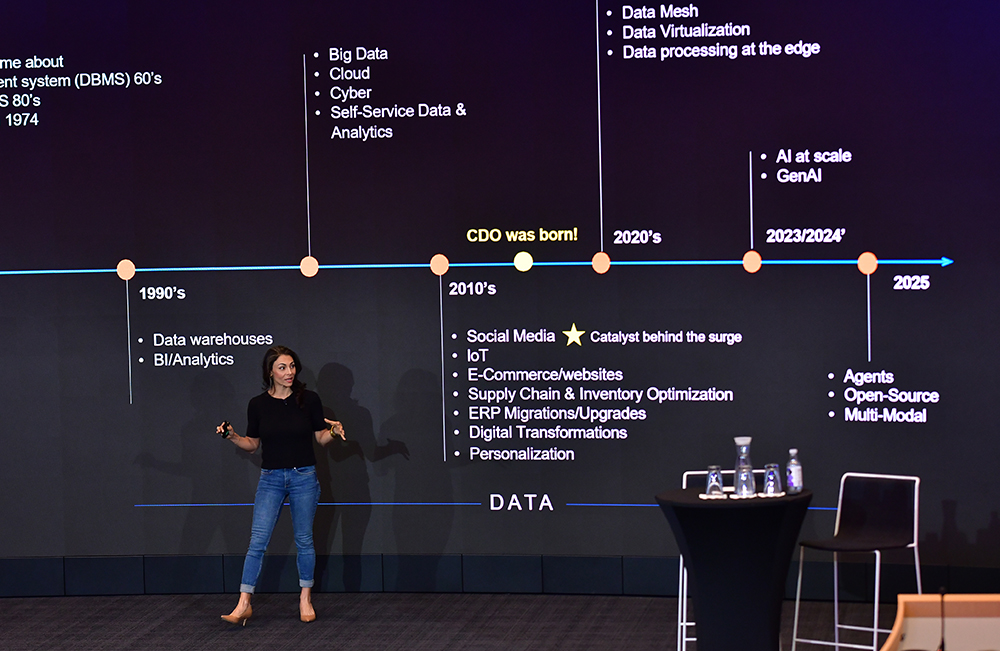
At Deloitte’s Chief Data and Analytics Officers Leadership Academy held by the U.S. CDAO Program, Rashidi, a seasoned data and AI executive and CEO of ExecutiveAI, shared why she now believes in regularly assessing her shelf life and reinventing herself—a mentality, she says, that has facilitated a wide range of experiences throughout her career and contributes to her comfort with adopting new technologies such as AI and making the most of emerging forms of data and tech.
As adoption cycles for new technologies quicken, Rashidi shares six lessons that fellow leaders can consider in this rapidly changing environment.
The ‘A’ in AI doesn’t necessarily mean ‘artificial.’ Rashidi doesn’t like the term “artificial” in artificial intelligence because she says it creates unrealistic expectations. To her, AI is not plug-and-play; it takes work. She points to three other “A”-based words she thinks better represent the current use cases: automated, augmented, and anticipatory intelligence, with a fourth around the corner—agentic.
Each of the A’s can establish a better understanding and a clearer view of what form of AI is being leveraged to enable a use case and paint a picture of what’s really being deployed. Rashidi says: “Automated intelligence is about automating repetitive tasks that have a low cognitive load, as no one should be copying and pasting data between applications. Augmented intelligence is about democratizing knowledge to remove the mundane and laborious exercise of memorizing product details or warranties and rebate terms, for example. Anticipatory intelligence is about seeing the future as a result of taking into consideration multiple market, business, and financial variables. It’s about predicting demand given a vast array of data.”
Manage expectations for AI effectiveness. Some people expect AI to function perfectly. “When have humans performed perfectly?” Rashidi asks. “The reality is, we make mistakes, and so do models. It’s unfair to say AI needs to be perfect. Instead, what should take place is a comparison of model accuracy and effectiveness with human accuracy and effectiveness to see which consistently delivers better results.”
Organizations should set reasonable expectations and deploy “acceptability thresholds” for AI outputs, Rashidi says. “That way, you might be able to say, ‘It’s not perfect, but it’s better than what we’re producing now, thereby crossing our acceptability threshold and allowing us to go live with this,’” she says.
Focus on people, not the tech. “The tech aspect of AI is probably the smallest hurdle,” Rashidi says. “Leaders can easily get caught up in questions like, ‘Which foundational model should we use?’ and ‘How many licenses should we buy?’” But with every data and digital transformation, the majority of work should go into business process re-engineering, workforce preparation, and security.
One aspect that sometimes creates drag and lag is unclear identification of C-suite responsibilities: A lack of ownership and consensus among the CIO, CTO, chief data officer, and other C-suite tech leader roles can potentially slow AI adoption, she adds.
Be purposeful in using AI. Rashidi believes in “intentful innovation.” Sometimes, innovation comes from adopting the latest tech; other times, it comes from cutting through the noise better than a competitor can.
“There’s a time and place for AI, but not every business problem needs to be solved by AI,” she says. “The debate I have with myself is, ‘Why am I using a chainsaw when I know that scissors are going to cut the paper?’ or ‘Why am I using a jackhammer when a hammer is capable of pinning the nail on the wall?’ Before jumping onto the AI bandwagon, tech leaders should make sure they are practicing intentful innovation and not just using AI for the sake of AI.”
Reorient how you measure business value. ROI is often unrealized in the first year and even afterward can be difficult to prove, Rashidi says. “We almost always focus on monetary ROI, and that can be a hard sell because it can take up to three years before you see a real return,” Rashidi says. “But there are other measures of ROI that are sometimes overlooked that can have more immediate benefits, such as relevancy ROI and cultural ROI.”
Leaders can ask themselves how certain moves now may position their organization for success down the line and how they are upskilling their people accordingly, even if these moves may not immediately show up on any balance sheet. She advises leaders to explore all forms of ROI that may contribute to the longevity of their company.
Keep workforce integration top of mind. Rashidi says a variety of issues can prevent organizations from effectively integrating AI and making it operational. One reason, she says, is workforce preparation.
“We don’t always put enough time into training our workforce,” Rashidi says. “It’s not enough to take a half-day workshop to learn a new technology. It’s more about the mindset shift of how we can help each employee become a force-multiplier with AI. How can they leverage this amazing capability while avoiding ‘intellectual atrophy’ that may occur with overuse? The key is to outsource tasks, not critical thinking, and to ensure any training is about that shift.”
AI is the “prom king” and data is the “prom queen,” according to Rashidi. The two go hand in hand, because effective AI is a product of good data. “The good news is, AI adoption is still in its infancy, so leaders should take their time to get data and AI right while also being mindful that time to market is a key differentiator,” she says. “Sometimes, slow is smooth and smooth is fast.”
—by Megan Turchi, writer, Executive Perspectives in The Wall Street Journal, Deloitte Services LP; Anjali Shaikh, managing director and U.S. CIO Program leader, and Lou DiLorenzo, principal and Monitor Deloitte U.S. AI & Data Strategy practice leader, both with Deloitte Consulting LLP